Architecture
Modern Architecture in San Diego
America's modernism showed up here early and never left. Where the houses are, who drew them, and what to check before you buy one.
Architecture
America's modernism showed up here early and never left. Where the houses are, who drew them, and what to check before you buy one.
Why they're hard to find
You can filter a portal by bedrooms, price and zip code. You cannot filter it by post-and-beam, by an intact clerestory line, or by whether the remodel respected the drawing. A great modern house and a gutted one look identical in an MLS export.
So finding these houses is manual work: knowing the pockets, watching them, and walking the ones that surface. That is the work this site is for.
The vocabulary
They trade differently, appraise differently, and attract different buyers. Know which one you are looking at.
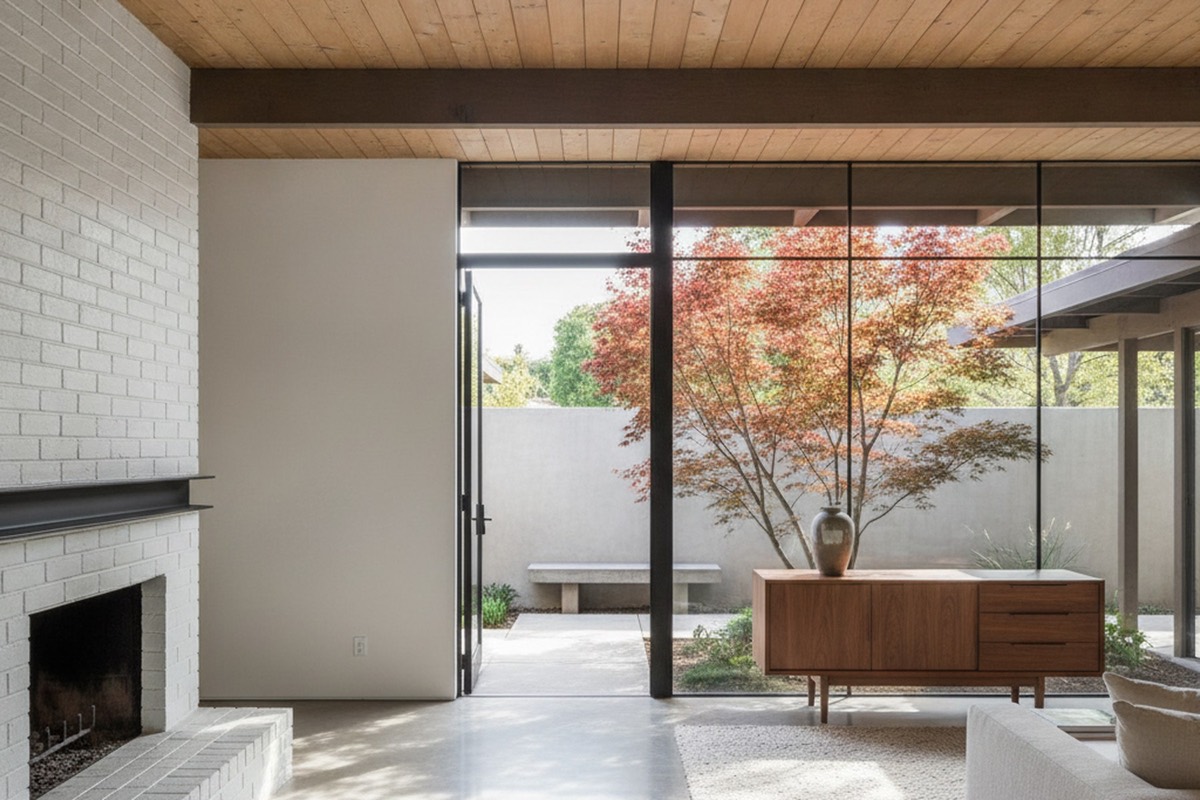
Post-and-beam structure, glass to the garden, a plan organised around a courtyard or a view. The value is in what survived; every original fixture and unpainted beam counts.
Redwood, stone and glass shaped to the lot instead of imposed on it — San Diego's deepest bench, much of it in the Frank Lloyd Wright lineage.
Built around water and a protected view corridor. The lot usually carries more of the value than the structure does.
Good bones brought forward. The question is always whether the renovation read the original drawing first.
Where they are
Six places do most of the work. Each rewards a different kind of buyer.
The deepest modern stock in the county, from Irving Gill's early concrete work — the La Jolla Woman's Club dates to 1914 — through mid-century customs in the Muirlands and on Mount Soledad, to the Case Study Program's Triad houses. Louis Kahn's Salk Institute anchors the north end. Expect competition; these addresses are known.
Mid-century customs on a peninsula with ocean on three sides — a favorite canvas for San Diego's postwar modernists, Homer Delawie among them. The light and the exposure that make these lots great are also what tests the buildings; inspect accordingly.
Organic modern above the bluffs. John Lloyd Wright — Frank Lloyd Wright's son — practiced from Del Mar for his last decades, and the sensibility stuck: wood, angles, and houses that defer to the trees and the view.
Hillside custom country east of the city — winding roads, view lots, and organic houses fitted to the slope, including work by Taliesin-trained Sim Bruce Richards. The trade-off for the architecture is the hillside itself: ask about geotechnical and fire-zone realities early, not late.
Sixties customs and architect-built pockets in the hills near the university — less famous than the coast, better value, and some genuinely underrated houses.
San Diego's 1950s tract boom. Not architect showpieces house by house, but honest mid-century stock at the county's most reachable prices — and the occasional original that never got touched.
The architects
San Diego's lineage starts earlier than almost anywhere in America.
Working in San Diego from the 1890s, Gill stripped architecture to arches, planes and early concrete decades before the International Style had a name. His La Jolla buildings are the county's founding modern documents.
The dean of San Diego's postwar modernists. Redwood, glass and restraint — and a generation of younger architects who came through his office.
Trained in Ruocco's office before building a defining practice of his own; much of his residential work sits on Point Loma and in the city's older hills.
A Taliesin apprentice under Frank Lloyd Wright who spent his career in San Diego — organic houses in wood, adobe and stone, many in La Jolla, Point Loma and Mount Helix.
Frank Lloyd Wright's son practiced from Del Mar for his final decades, leaving organic houses through Del Mar, La Jolla and Rancho Santa Fe.
Louis Kahn's Salk Institute in La Jolla and William Pereira's Geisel Library at UC San Diego are the county's modern landmarks — worth the visit before you go house-hunting, because they calibrate the eye.
Buying
Original windows, beams, built-ins and rooflines are the value. Photograph everything and find out what was replaced, when, and with what.
Decades of casual additions are common in the hills. Pull the permit history before you fall in love — unpermitted square footage cuts both ways at appraisal.
Hillside and canyon lots are where the best houses sit — and where geotechnical reports, brush-management zones and insurance realities live. Ask early.
A one-off house has no neighbors that look like it. Expect appraisal friction, price it on the architecture's real market, and bring patience.
Contact
Tell me what you are looking for, or what you own.